Pages

Showing posts with label Polyducto. Show all posts

25 October, 2016

The Day After Monday


That would make today Tuesday, 25 October, 2016. Just think, only thirteen and a wake-up, as we used to say in the military. That's enough on that topic.

I talked to Mario this morning about having the pool pump and the waterfall pump raised up about knee-high in the pump house, so that they will be easier for me to work on them, replacing bearing kits, or O-rings, etc.

He reminded me that to maintain the prime, each of those pumps have to be slightly below the water level of the pool. Oops. I had completely forgotten that basic fact. Oh, well. Pumps get to stay down low. The valve manifold will be elevated for ease of operation and ease of repair should the need arise.

I also talked to Mario about getting Bani, his electrician to sort out the wiring for the Mennonite house so that the Mennonite house and the laundry room are on one circuit and one meter. The rest of the downstairs (the basement) and the pool house, pool and well will all be on the other meter and circuit.

Part of this project will also be to get the gate doorbell to work again, so we can use our new WiFi doorbell, Ring.com (https://ring.com). Actually, the old doorbell doesn't need to work. What needs to work is the current. There needs to be 12-VDC to the doorbell for the new one to work. It's wireless in operation, but it needs the 12-VDC to power the device. There is a rechargeable battery version, but I wanted to go with the powered one.

Right now we only have one meter. Luckily, I checked the other day, since I'm an old fart now and have a Golden Citizen Social Security card, about the discount available on the electric bill. Yes, there is a discount of up to $18.00 BZD per month, but only a certain number of accounts get it each year. Kind of a lottery sort of thing, and the available slots are closed for this year. We'll be in the running for next year. That's not a big thing for us.

What is a big thing, is this. With my Golden Citizen Social Security card, if we want to get a second meter, there is no charge for that from BEL. Since we're looking to split the buildings into two metered accounts, that is just perfect for us. I will be taking advantage of that as soon as Bani gets the circuits squared away. Something to keep in mind.

So, today's workday follows. We had a fairly good amount of rain last night. So far, today is the usual gorgeous Corozal morning.

Polyducto Creeping Around
A new run of polyducto this morning going from the pump house to the utility room to provide power for the pump timer. It's getting close to the deadline for running water and current as the deck and ramps are scheduled to be cast sometime this coming week.


Plastering Guides Up on Beam
If you're wondering what the wood strips fastened to the edges of the beam are for, why they're plastering guides. They're set to extend about 1/4" to 1/2" beyond the edge of the beam. Then plaster is applied and smoothed to the height of the guides. Once that side is dried, then the same thing is done with the next side till all four sides are done.


Timer Box Being Installed
I mentioned the timer box. Well, here it is. No wire yet, but as you could see with the polyducto, it's on it's way.


Plastering Unifies the Beam
You can see from this before (left) and after (right) that the plastering really does smooth things out and helps unify the whole thing.


Bani Running Wiring to Timer
Working in the somewhat confining quarters of the utility room, Bani is running wires to the timer. It's a challenge as he's running six wires in a very narrow surface wiring channel.


04 October, 2016

Monday, Monday

03 October, 2016. Back at work. Doggies in the pen, Nelson asleep in the 'basement', April sleeping in the closet. Dianna checking Facebook kitteh pictures.

Roof Overhang #1
The roof overhang will be on three sides of the pump house. The water-side will not have the built-in overhang. The overhang will be about one foot. Its purpose is to help keep rainwater from infiltrating the door and window louver.


Pump House Column Form
The column in the photo on the left side of the pump house presented some real problems during the pour. part of the form near the bottom gave out as the pour was going on, necessitating one of the guys to be positioned at the base, shoveling concrete into buckets to be re-poured from up above.

That finally got under control only to have a couple smaller leaks develop just above midway and up near the top. Neither were big deals and were quickly fixed.

Indir Shaping Column Rebar
Endher is busy bending the column rebar, to bring the pieces closer together, and trimming them to a specific height. The reason he's doing that is those pieces of rebar need to fit inside the chain rebar so that they maintain an even profile. Otherwise, there is no way to keep the chain aligned and smooth.


Bani Threading Polyducto
Just before the pour began, Bani, the electrician, fed Polyducto (the orange tubing) into various parts of the pump house. Think of it as flexible conduit.


The Roof Pour is Underway
And the pour gets started. A lot of labor hauling those buckets from the mixer to the roof. A young man's game for sure. Although Indir tells me there's a member of the professional crew that does these pours every day, who is around 56 years old and very fit. Still doing pours of  100-200 bags a day, and doing it very well. Indir said he's going to try and get him for our pour.


Roof Pour Completed
Here's the completed roof. Looks pretty good to me. A lot of work went into it.


05 June, 2010

Pulling Wire

Or, the Further Adventures of Electrician Man...

But, first we need to cover the rest of the window bit even though it occurred more or less simultaneously with pulling wires, etc.

As you no doubt have seen, after the windows were installed, many of the windows still had a bit of gaposis under the louvers. This is standard practice down here. I don't know if its because of different spacing between individual louvers or different mechanical functions in the way the louvers are actually opened or closed, or what. Anyway, the practice is to leave some gap at the bottom that, after installation, is then back-filled with mortar, finished and painted. So that's what's happening here.

In this photo, Mayo is tucking mortar into the gap under the window frame and smoothing it out. They even install a small wood form to square-up the front edge.
Mayo finishing the window bottom
As you can see from this next photo, Mayo has also placed a form inside so it gets finished on both sides and painted.
View From the Other Side
So, once the mortar work is done, then the raw mortar is primed and that is allowed to dry - which down here doesn't take long at all. Here, you can see Malo applying the terra cotta finish coat to the window. That's it - all done.
Finishing the Windows
At about this same time, I brought out the little air-conditioning units for the bedrooms. In this view, you can see one of the units already installed and Mayo re-sizing the other opening. This opening was made by a guy that worked for Isidoro for a couple of weeks. Even though the correct measurements were written on the wall for him to follow, one opening ended up right and the other ended up wrong. Go figure.
Fixing the A/C Opening
Each unit was fastened to the wall with L-brackets and TapCon screws, then spray foam shot around the inner edges, which was then trimmed and caulked, and finally painted, so from the inside, they look really finished and 'built-in'.
A/C in #2 Bedroom
------------------------------------
Ok, now to the adventures of Electrician Man.

One of the things about concrete houses that we were essentially unfamiliar with, is how wiring is run in a concrete house - well, at least how it's usually done here in Belize.
Joe Pulling Wire
To run wire, folks usually use a product called Polyducto as a kind of flexible conduit for the wiring. it's basically an orange-colored tube, about the consistency of a common garden hose and is sold in 50' rolls (maybe more).

The Polyducto is positioned within walls and floors and ceilings as the house is built up, which is fine as far as that goes. What is supposed to happen is that each end of the tubing is capped with tape to prevent concrete running into the tubing when the concrete floors or ceilings are poured. What can also happen, since the tubing is flexible, is that it can easily collapse under the weight of concrete - especially if someone steps on it during the concrete casting process.

In either case, the electrician then has to try to break through the concrete plug in the Polyducto, or to try and force wiring through a pinched bit of tubing.

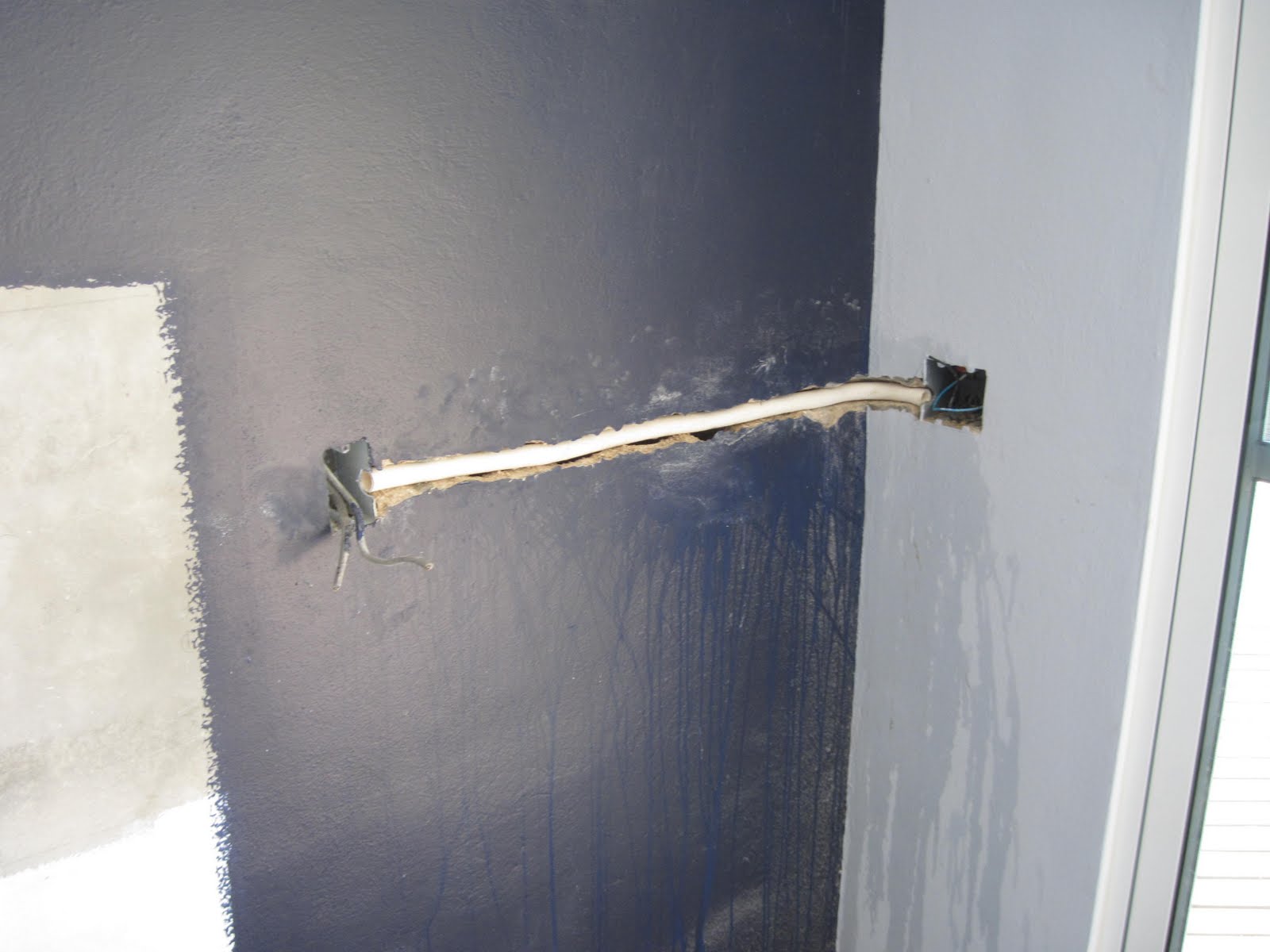
If they're unsuccessful doing that, then what has to happen is what we had to do. Channels have to be cut in the wall to run Polyducto or some similar product to allow circuits to be completed. In this example, Malo is cutting a channel from a working power circuit up to a switch that will control an outside motion-detector light.
Cutting a Channel
Running channels around corners presents other issues as well as the aforementioned kinking problem. Corners, like this that Mayo is cutting, below, frequently have concrete columns that were cast before the wall was built and are much harder to cut through and consequently, to run the wire.
Mayo Cutting A Corner Channel
Of course, this would all have been easier if there had been no paint on the wall. Hmmmm, I think there's a lesson in there somewhere.
Mayo Patching the Channel
We had to have the guys cut about six channels and in addition, they also had to run some surface wiring in places where cutting a channel was simply not practical.

Of course, each channel means it has have Polyducto added to it, then it is patched with concrete and smoothed out to be ready for painting.
Final Smoothing of the Mortar
In this example, we used some flexible tubing in order to make the tight corner bend. Polyducto would not have been good for this tight cornering.
Corner Bridged
Once you have it all smoothed and dried, then it's ready for priming and painting. Hopefully, you'll be able to match everything up properly and the cut won't be too noticable.
Ready to Go
------------------------------------
 One last item for now. I also got the on-demand water heater installed and hooked up. I don't, as yet, have a butane bottle for it, nor do I have a vent pipe for it nor a hole to vent the pipe out. That'll all come when it needs to. Showering right now, I don't know anyone here who uses hot water for showering at this time of year.
On-Demand Water Heater
Well, that's it for this issue of 'Electrician Man'. Stay tuned for more adventures as they come.

30 December, 2008

Tuesday Evening Update

Now, after a fairly hard day for the guys, it's beginning to look quite like a house. As the walls go up, so does the preliminary work for the electrical wiring. Below is a shot of Isidor running some of the Polyducto - an orange-colored, supposedly semi-rigid, flexible tubing.

It works fine until or unless it's compacted by the weight of concrete, or if it kinks in a bend. Several "experts" say it doesn't get compressed by concrete. That I have to dispute. We've seen several instances where just that exact thing has occurred. It also tends to kink easily, and even if not compacted by concrete, simply will not allow any sort of movement to run electrical wire through its tubing.
Esidoro Working Polyducto
It would probably be better in the long run to do electrical runs using schedule 40 PVC, but that would take longer, more labor, and probably cost more.

The two photos below show just how fast the walls are going up on this project.
Walls Appear to Go Up By Themselves
Apparently They Are
Late this afternoon, we're at the height for window positions to begin to be seen. You can see the kitchen window notch on the right side of the photo. The three boards are down on the deck to protect the deck wood from the heavy traffic of the workers. Same for the chairs upended - to keep them from using the deck as much as possible.
Worker Pathway
Miss Blue is an excellent escape artist. She simply never gives up and is always near a door when you go out or come in. And she's fast too.

On one of her legitimate excursions this evening, while she goes in search of grass to eat, to help that "full-body experience" that only cats can emulate (throwing up furballs), I shot this picture of her being quite serious while she's looking for more grass to much while she's up on the drain field garden.
Miss Blue Looking for Grass
Here's a last glimpse for this evening of the guest house from the edge of the pool deck. If you look closely, you can tell that both bedrooms are chock-a-block full (so to speak) of blocks for work over the next few days.

The block company only delivered three truckloads of block here today, so we've got a sh**load of block for the guys to go through.
Sunset View of the Guest House

14 December, 2007

Up To Speed As Of 11/27/07

Bringing you up to speed, we'll start with the front stairs. The pour went well, but then it began to drizzle. Since we don't yet have any gutters up, rain began to erode the poured concrete.
Front Stairs After Concrete Pour

I zoomed into town to find some Visqueen. Of course, this is something no one here has heard of.

At Villa's Supply, I finally found a roll of black plastic for $30BZ, which we put to good use protecting the stairs.
Plastic Sheeting Protecting the Stairs
All Stretched Out

After the rain quit, I carefully retrieved the plastic, folded it and saved it for some other use. It's too expensive down here to not do that.

I also checked at "The Store That Has It All - Cinty's" - to see if they had Visqueen or disposable drop-cloth plastic, you know, the almost Saran-Wrap like plastic that works for one or two uses and then you pitch it. He knew what I was talking about, but didn't have any. He did write it down to see if he could get it in the future.

Now we move to the back of the lot, or the canalside. Here's a view from the front porch of the activity going on constructing the fence back there. The fence will do several things - hinder bad guys trying to get in, keep our dog or dogs (which we don't have yet, but are looking) in the yard, keep the crocs out and from having the dogs as a quick snack.
Canalside Fence Construction
One of the things we wanted to do was to have some dramatic lighting back by the canal. It would look cool at night, and if we ever get to have boats back there, would really look snazzy coming in to a nicely lit boat slip at night (ah dreams...).

To that end, we had Isidoro and his crew prep for lights by including some tubing to run wiring through. It's called "polyducto" - not sure if that's a brand name or what, anyway, that's what it's called.
Running the Polyducto Along the Fence
Each Post (10 of 'em)
 Will Have a Light
Showing the Post Rebar and Polyducto
Here's the inside of the house prior to the walls going up inside. Man, does it look different from this now (you'll just have to wait till I get the pics posted).
Bare Bones
"The Machine" as the workers call it, makes life much easier for them on a large pour. Otherwise, it's out in the street hand-mixing concrete. This one belongs to Franz. And it works pretty good except when its broken - which is once in a while. That's not unusual down here. Stuff breaks - a lot by our standards, but it's just part of living in paradise.
The Machine
Some more views of the canalside fence going up. It'll have a nice scalloped shape to it in a few days. You'll see, trust me.
Gate Opening
Getting ready to Pour the columns
The guys hard at work placing the blocks and filling them with concrete.
Canalside Fence Taking Shape
And just to show you that Blue and Midas have taken things in stride, here's a shot of them supervising the construction. This shot was in the duplex we were in for November. We've since moved again to Jim and Melanie's house (our third place since we've been in Belize!).
A Couple of Hard Workers