Pages

Showing posts with label Corozal Town Council. Show all posts

01 August, 2014

Welcome to Corozal

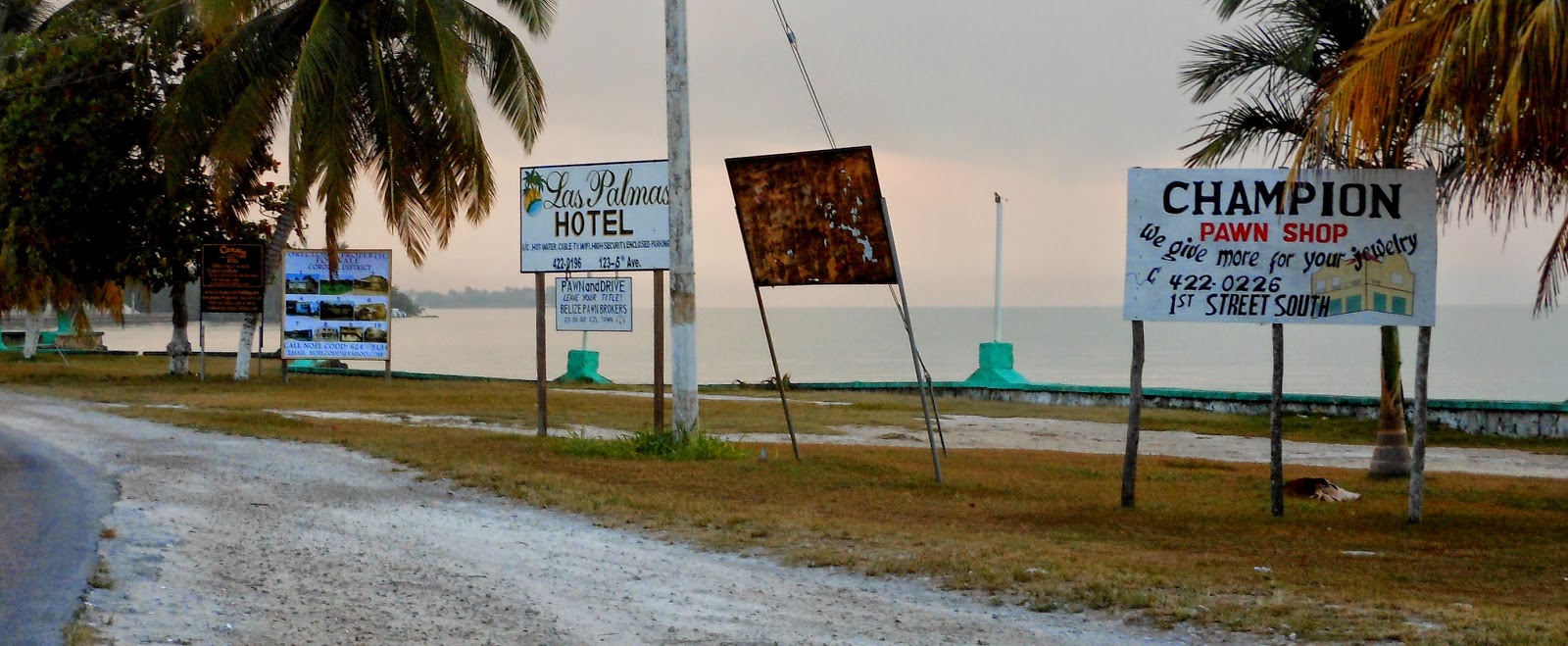
Welcome to beautiful Corozal. Guess what the first thing is that you see when coming into Corozal from points south on the Phillip Goldson Highway (formerly the Northern Highway)? Is it the view of the beautiful bay with its ever-changing colors? Hardly. It's an increasingly ugly display of commercial billboards - right on the water side of the highway.
What An Atrocious View

The Corozal Town Council, in their wisdom, doesn't mandate that billboards occupy the land-side of the highway, where they would still be ugly, but far less intrusive to the view of everyone. Oh no. They have to be placed front and center. It really makes one proud to live in a town that used to have an almost unobstructed view of this gorgeous bay.

Billboards, along with a slowly creeping increase of construction on the water-side, is slowly ruining the premier waterfront parks and unobstructed views that have been the jewel of Corozal, and made it such a treat to see.

Now you can get a glimpse of the water, and an idea of how it used to be. One can only hope that Corozaleños, both native and new arrivals, will let the Corozal Town Council (http://www.corozaltowncouncil.bz/) know just how much they appreciate the beautiful waterfront views they now have. Just press the 'Contact' button to leave them a message. I'm sure they'll respond 'right now.'

12 September, 2013

Potholes and Speed Bumps

Potholes and Speed Bumps - That's just about the Yin and Yang of it right there for Belize roads.

Since I think that I might just get tired writing about the rain - I mean, rain is rain is rain, and we've certainly been getting our share of the stuff. It seems like we have been anyway. We lived in the Northwest part of the U.S. for a bit better than twenty years, so we know all about rain with nine months of it at time.

We moved to Corozal, because this was one of the 'driest' spots in Belize (we tried to find the Great Mayan Desert, but that apparently got misplaced somewhere). Now, this stuff, happening every day, seemingly forever for at least the last three or four weeks anyway, just kind of puts a capper on it.

So, how about I write about speed bumps and potholes instead? What brought these two things to mind was a posting on a blog I saw the other day: Speed Bump (http://what-if.xkcd.com/61/). Now, I know it might seem like there's no connection between rain and speed bumps... well, there isn't. That's why I mentioned the blog posting above. But what about potholes, you ask? Now, there is a connection between potholes and rain. Potholes may not necessarily be caused by rain, but, in many cases, they're exacerbated by rain.

Sure rain softens the marl, and that leads to creation of potholes, even patched potholes on pavement, since they use marl as the fill of the hole and then cover it with a thin layer of asphalt. I'm sure there's other causes, but those are the only ones that come to mind right now.

Speed bumps, somewhat unsurprisingly, if you take them  at speed, can and do cause a variety of back injuries and vehicle damage. For example, some articles have said that the vertabrae 'L1' was the most frequently fractured vertebrae in accidents, and accounted for about forty-four percent of injuries.

It was reported that 'people are occasionally injured by speed bumps.' Here in Belize, with the number of speed bumps we have, that would seem to be a 'no-sh**' kind of statement. But, the literature suggests that nearly all of those injuries happened to  people sitting on hard seats in the backs of buses, and/or 'riding on poorly-maintained roads.' I think this is another of the above kind of statement. Ahh, poorly-maintained roads... something we're completely unfamiliar with here.

So, it seems that, here in Belize, we're faced with a three-edged sword, if it were possible, consisting of speed bumps, pot holes, and poorly maintained roads.

Lincoln Eiley, author of the Corozal Daily... (Sometimes) newsletter, just did a piece on poor roads in the Corozal area. He focused mostly on the tourism potential, mentioning the border inspection area,which has always been an eyesore, as the thing that greets new arrivals to the Belize northern border.
Arrival Area Belize Border. Courtesy Corozal Daily
He also gave mention of 7th Avenue, and that it is the responsibility of the Ministry of Works and Transport, but they're obviously short of money, so the Corozal Town Council has made several repairs to that stretch of road. Gosh, it'd be nice if the Town Council, the Ranchito Village Board, or the Transport Department (same thing as the Ministry of Works and Transport, just easier and faster to write. So, it's understood that Works Dept. or Transport Dept. pretty much means the same thing - at least in this context.) could see their way to fix the stretch of road in our area, but that's probably way too much to hope for in the next day or two.

I'm guessing that potholes can cause just as many injuries and damage as speed bumps. They're, more or less, 'negative speed bumps'. Even at low speed, potholes have the potential to cause injury and damage. Several times, I've actually had the steering wheel of my Isuzu jerked out of my hands when hitting a pothole. How is that possible, you ask? Well, with rainfall comes the hiding of potholes when the roadway is covered with water. All too easy to really whack a pothole when you can't see them.

Speed bumps are designed to make drivers slow down. Potholes are not so much 'designed', but they are just as effective at making drivers slow down. The two main things protecting you from either hazard are your vehicle tires and suspension. The tires absorb the shock of striking the speed bump or pothole by compressing. This is called the tire's 'cushion.' It's the separation between the bottom of the rim and the ground and is about three to four inches, unless you're running those ridiculous low profile tires which might be OK up north on manicured road surfaces, but here, with our roads? Naturally, we still see them on some sporty vehicles.

Of course, if you hit a speed bump or pothole hard enough, the tire might compress such that it exceeds it's design limits for compressibility and explodes, or if the speed bump or pothole is large enough, permanent damage to your vehicle can be the result, not to mention, what potentially can happen to the people riding in and on the vehicle. I'm thinking here of people riding in the backs of pickup trucks and in the beds of other types of trucks.

If you hit one of the really large speed bumps (the official name for these monsters is a 'speed-table', well, all bets are off. You'll probably be launched into orbit.

Here in Belize, these huge speed bumps do double duty. They mark pedestrian rights-of-way, one of the few places where pedestrians have the right of way.

Just a final note here. I've talked to at least a couple of people who have talked to representatives of the Ministry of Works and Transport here in Ranchito, who have assured them that help (or salvation?) was on the way. In looking out my window, so far, all I see is more rain. Several folks have gotten stuck, some able to extricate themselves, some having to wait for friends to tow them out. It'll get better as soon as the dry season arrives... I'm sure.

13 October, 2012

Learning To Hate Bulldozers and Dump Trucks

So, how much do I dislike bulldozers and dump trucks? Well, probably about this much (I guess you'll have to visualize a lot. This is after having to listen to them just about every day for well over a year now - all day long, every day. Most days, it starts around 7:00 AM and frequently goes till 5:30 or 6:00 PM. Just shy of twelve hours in a twenty-four hour period.

We always knew that our living in the bush on the outskirts of Corozal would end some day, but we sort of figured that it would happen one plot of land at a time. We certainly never dreamed that everything would happen all at the same time, all around us, all day long, every day.

There are bulldozers and then there's a bulldozer. Most of the dozers have adequate muffling of their incessant droning but one that works the development right next door either has no muffler or the one it wore out a long time ago. Believe me, an unmuffled diesel engine on a dozer is a killer.

Not to say that I totally hate dozers. I still have a fond memory of Ed Sosa, who delivered the fill for our lot and also provided the dozer to level and compact it. Keeping track of trucks delivering the marl fill was a pain. But, then we only had three or four trucks to worry about… and no neighbors who would be getting upset.

One thing I remember was the difference between watching a dozer work and riding one. I had been taking photos of the progress as Ed worked his dozer around. I got the bright idea to hitch a ride on the behemoth and snap a few pictures. Which I did. It was simply amazing. What an incredibly rough and jarring ride. There's no, repeat, no suspension on those things and you feel every bump and pebble in its path. It certainly looks different from the ground level, because once you're aboard, wow! 

Then there's the dump trucks. They go right past our house less than 30-feet away from our back porch. They're either slowing as they pass our house, with brakes squeaking and screaming, loud rattles and bangs, or they're accelerating in the opposite direction, with their diesel engines revving up extremely loud each time they go by. Try watching TV with all that racket. You'd best keep the remote at hand and your thumb on the volume control as you're sure to miss every key bit of dialog or the punchline of each joke. It's uncanny, but they never seem to make noise during commercials - of course.

Of course, there's also other vehicles - the odd buses, delivery trucks, and assorted other conveyances. And before I forget, Fruta Bomba, Ltd. (Fruta bomba, in Spanish means papaya, which is one of the crops they grow here) has opened a couple of new fields somewhere to the west of us, so there is a big increase in agricultural traffic, trucks and tractors, caused by those folks. Fruta Bomba is a part of Brooks Tropicals (http://www.brookstropicals.com).

It's amazing how chemically intensive commercial papaya growing apparently is, judging by the amount of chemicals, sprayers, and applicators, etc., that pass our house almost daily. And I guess I should also include the seasonal traffic of the cane trucks as they come and go with the sugar cane harvest, but by comparison with the dump trucks, Fruta Bomba's trucks and tractors and the cane trucks are all relatively minor irritants.

The fortunate thing about all this is that after roughly 6:00 or 6:30 PM, traffic pretty much goes away for most of the night, with the odd exception every now and then of some very heavy-sounding vehicles that pass by at 'oh-dark-thirty' as you're trying to sleep.

The one saving grace with all the construction happening at the same time is that somewhere down the road, this too shall pass. All the dozers and dump trucks will go away and relative peace and quiet will return.

Oh, before I forget… I didn't mention how our road itself is doing with all this traffic. The dump trucks especially, have been very hard on it. The intersection just to the north of us has become a veritable roller coaster on days that it's dry. On the rainy days, it usually becomes a bottomless quagmire thanks to the heavy weight of the filled dump trucks converting the marl base into a sticky, glutinous muck.

Today's a good example. After attempting to walk the doggies into town this morning, Twyla and I reversed course and walked the girls south toward Mike and Mary's house a mile or so past our place. While there, we took the opportunity to inspect George and Sue's place on the waterfront. They've actually got some steel going up and a great big pile of concrete blocks. There's also a lot nearby that will be starting construction very soon. One of the Mennonite well drilling rigs was still on their place. It looks to be in the final stages of getting a water well punched through.

After walkies was done, I got a call from Twyla regarding one of the folks working at the house that Mae and Craig are building across the street from us. Apparently, he got his vehicle stuck in the goo of the intersection. Of course, dump trucks are still running, so that is going to get chewed up even worse, and the ever-present rain is still with us, threatening at any time to dump a load, making the intersection just that much worse.

At Least Four Vehicles Got Stuck Here Yesterday
Dianna and I decided that, instead of allowing our friends to try and come through all that mess for this afternoon's happy hour (our Friday afternoon informal get-together at our pool) that we would opt on the side of safety and just cancel this afternoon's soiree, much to the consternation of one of our friends who greatly enjoy the time spent in the pool - not our company, mind you, just the pool.

The real concern here is that if the intersection gets bad enough, we're stuck. Everyone who comes this way has virtually only one other way to get to town. And that involves a ferry ride and about a three-hour trip to Orange Walk Town and around to Corozal. There is no other road. Medical and fire transport would be facing the same issues, so it's potentially a bigger deal than just someone getting stuck for a few minutes.

Maybe it's time for government (Corozal Town Council, Ranchito Village Board, and Department of Transport?) to consider installing a culvert and constructing a drainage ditch to the canal. That would be a permanent solution to a problem that only seems to be getting worse as more development occurs and with each rainy season.

Additionally, the trucks create create clouds of dust and great gaping potholes that are amazingly hard-edged. This makes for holes that can literally jerk the steering wheel right out of your hands (and that's at less than 10-15 miles per hour) if you're not expecting it - especially when the potholes are filled with water, so that they become invisible.

There is one good thing about the potholes - they force everyone to slow down. That is wonderful, because when the road is freshly graded, Katy bar the door. The rule seems to be enforced that you must go as fast as your vehicle is capable of going, which often is more noise than speed, due to the dilapidated state of repair of many local vehicles (ours included, although I rarely get over 15-20 MPH on our road). So, potholes can be a good thing.

Someday, all this will be looked back on fondly through the rose-colored specs of remembrance. Till then, it's tempting to think about cheerfully monkey-wrenching (thanks Edward Abbey) each and every dump truck and dozer that comes our way. At least dreaming about it is satisfying.
02 May, 2011

So Why Make Rules?

About two weeks ago or so, the Corozal Town Council (CTC) had a worker diligently putting up signs all along the waterfront park areas. The signs read: "No Parking On The Beach. Fine Of $50.00 - CTC," as you can plainly see in the photo blow-up below.
Here's One Of The Signs
So, ever since the signs went up, the waterfront park activity has continued pretty much the way it always does - vehicles seeming to enjoy the park as much as people. They must, since the cars are parked all over most of the park areas.

It's not like the parks don't get crowded, they do. That's one of the cool things about Corozal - its waterfront parks really do get used every day, by a lot of people. Especially on weekends, the crowds can be quite large. It would be great to have all this space for people.
Some Of The Many Vehicles In The Parks
Maybe the CTC isn't going to enforce parking rules such as this on the weekends. That sounds logical in a way, but, I go past a good stretch of the waterfront park areas several times just about every day. And, it's the same thing, cars parked willy-nilly all over the waterfront park areas.

And, it's not like there's a shortage of street parking close to the park. Just the opposite. There's plenty of parking on the street. More than enough to cover all the cars parked in the park with plenty left over.
Another Park - More Cars
One has to question... Why make rules when there appears to be absolutely no intention of enforcing them? It must be like so many rules here (not just Corozal, but the whole country) - kind of a 'wink, wink, nudge, nudge' sort of thing. The rule looks good on paper, but takes too much effort to follow through.

Why waste the time to put it on paper? Why waste the paper? I wonder how much it cost to have the signs made and to get them all posted?